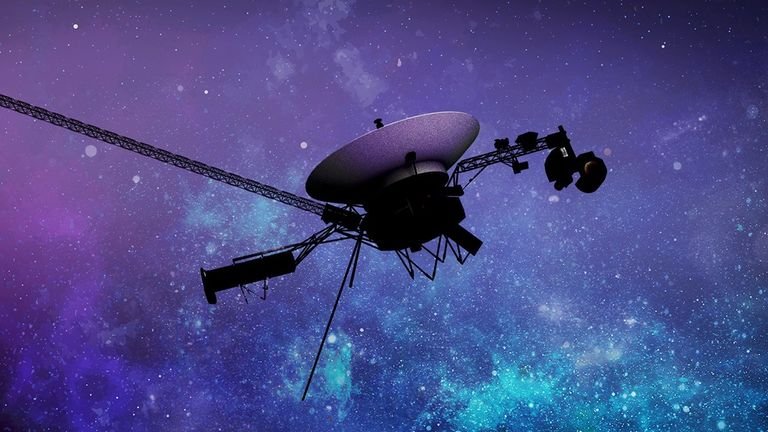
At 5:16:07 a.m. ET on Wednesday, November 18 (2:16:07 a.m. PT), NASA’s Voyager 1 will be one light-day from Earth: 16.094 billion miles away, the distance light covers in 24 hours. You can follow the moment from your phone, for free, on NASA’s Where Are Voyager 1 and Voyager 2 Now page.
No human-made object has ever been that far from home. Voyager 1 launched on September 5, 1977, and it has taken almost half a century to cross a gap that light jumps in a single day.
Two NASA tools, no app to install
The quickest option is NASA’s Voyager status page. It shows a countdown clock to the milestone and links to what NASA calls “cosmic odometers,” which follow each spacecraft’s progress.
For something more visual, open Eyes on the Solar System, NASA’s 3D interactive visualization tool. Its Voyager 1 view is set to show the spacecraft’s distance from Earth. According to NASA, the Eyes apps run in any modern web browser, phones and tablets included, with no download or sign-up.
The crossing happens before sunrise across most of the country, so plan ahead if you want to see the countdown hit zero. On the West Coast, that means a 2 a.m. alarm.
What one light-day means for the people flying it
A light-day is a distance, not a stretch of time. Radio signals travel at the speed of light, so once Voyager 1 passes that mark, a command from Earth takes a full day to arrive, and the reply needs another day to come back. Suzanne Dodd, Voyager project manager at NASA’s Jet Propulsion Laboratory, has described it simply: you send a message, then wait two days for an answer.
NASA is also clear that nothing physically changes when the line is crossed. The spacecraft keeps cruising through interstellar space at roughly 38,000 mph.
The milestone comes after a tense few weeks. On October 18 and 19, NASA’s Deep Space Network couldn’t detect Voyager 1’s signal during two scheduled attempts. The signal returned on October 20, and as of early November engineers still didn’t know what caused the pause. They did find that one set of thrusters had stopped working and that the spacecraft switched to its backups on its own.
A number you won’t see again for years
Voyager 1 still runs two science instruments, one that measures magnetic fields and one that listens to plasma waves, according to NASA’s mission page. Its twin won’t get its own turn anytime soon: NASA expects Voyager 2 to reach one light-day in November 2035, and CNN reported that even optimistic estimates don’t have it operating that long.
Set an alarm for 5:16 a.m. ET on November 18, then open NASA’s countdown and watch it run out.